 English
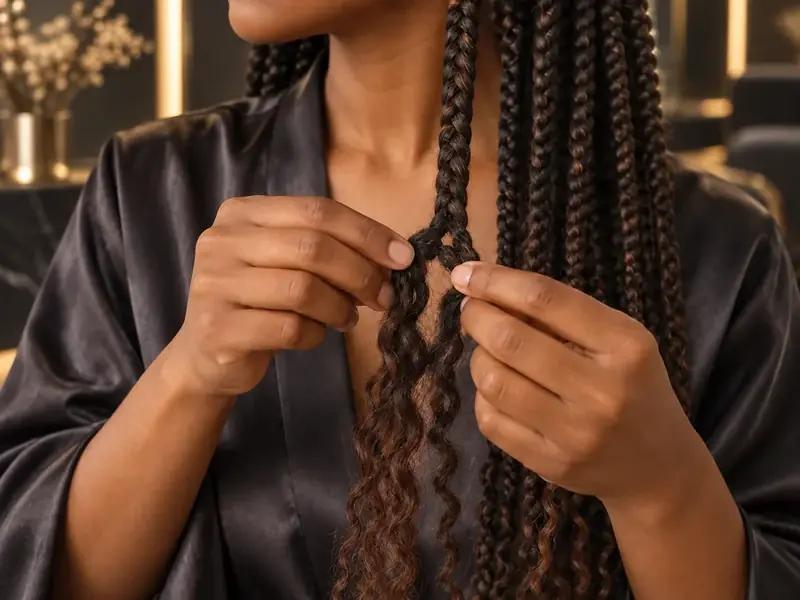
To take out braids, start at the ends and undo each crossing with your fingers, without pulling at the roots. Work on one braid at a time, separate any added hair and detangle the section before letting it join the rest. If a knot will not loosen, stop: pulling harder is not the next step.
In this guide
This guide is for cornrows, box braids and knotless braids that can be unplaited. Locs, glued or sewn-in extensions and severely matted hair need a different approach. If you are unsure how the added hair is attached, ask the person who fitted it.
Is it time to take them out?
If you are still unsure when to take out your style, check the wear-time guide first. Then come back here for the takedown steps. If your hairstyle is painful or pulling, do not wait for a planned date.
Check braid wear times and when to take them out
Before you start: get everything ready
Set aside some unhurried time with good lighting and a mirror. If you have lots of braids, plan breaks. Keeping what you need within reach makes it easier to stay patient as you work.
- Gentle sectioning clips to keep loose hair away from the remaining braids.
- A wide-tooth comb without broken teeth or rough edges.
- A detangler suitable for your hair or a conditioner, used and rinsed as directed.
- A towel and somewhere to put the removed extension hair.
You do not need to cut the extensions to follow these steps. If you cannot clearly see where your own hair ends, put the scissors away. Your hair may be different lengths in different sections, so an estimated cutting line is not a reliable guide.
Undo one braid at a time
- Clip the other braids out of the way without pulling them into a tight ponytail. Carefully remove any beads or bands from the braid you are working on.
- Support the braid above the area you are undoing. Start at the tip and use your fingers to release one crossing at a time, moving your hands upwards as you go.
- Separate the extension hair as it becomes loose. Do not pull the whole bundle out at once: some of it may still be woven into your own hair.
- When you reach the base, separate the strands slowly. Detangle that section before moving to the next braid and keep it loosely out of the way.
For cornrows
Start with the free-hanging part of the braid and work towards the section along the scalp. Release the hair picked up at each crossing instead of lifting the whole row at once. A mirror or another person's help makes the back easier to see.
For box braids or knotless braids
Whether the braid begins with a knot or has hair fed in gradually, the rule stays the same: undo it from the bottom. Give the attachment at the base and any loose boho strands extra attention. Do not comb through a braid that is still plaited.
Detangle in sections, starting at the ends
Use your fingers first to separate tangles that loosen easily. Then work with the wide-tooth comb in short sections: ends, mid-lengths and, once those are clear, the hair nearer the roots. If the comb catches, go back to your fingers rather than forcing it through.
There is no single rule to always detangle dry hair. The AAD advises combing thick, curly hair with conditioner before rinsing, and letting straight hair dry a little before combing. Adjust moisture to your texture and product; soaking a still-plaited braid does not mean you should pull it apart.
AAD: hair care and detangling for different hair types
What to do with a tight knot
Set that section aside and look for the edges of the tangle. Use your detangler as directed and try separating small strands from the outside while supporting the section. Do not push a metal point against the scalp or scrape product build-up with your nails.
If the strands will not separate, the hair is matted or you have to pull to make progress, leave that area and seek help from a stylist experienced in braid removal and detangling. A written guide cannot assess how much hair can be preserved in an individual case.
Afterwards: washing and a comfortable style
Check each section before bringing them together. Gently cleanse your scalp and rinse products as directed. Use conditioner as part of your routine and dry without rubbing with the towel. Choose a comfortable style while checking how your hair and scalp feel.
No fixed number of rest days guarantees that everything is fine. If pain, stinging or irritation remains, do not put the area under tension with another set of braids. Seek dermatological advice for sores, crusting or visible hair loss. Keeping a hairstyle should not mean accepting pain.
AAD: signs of tension and when to seek advice
Related guides
An editorial guide by AC Trenzas Studio. Scalp-care recommendations are supported by the linked sources and do not replace an individual assessment. The image is illustrative and does not document a real braid-removal session.