
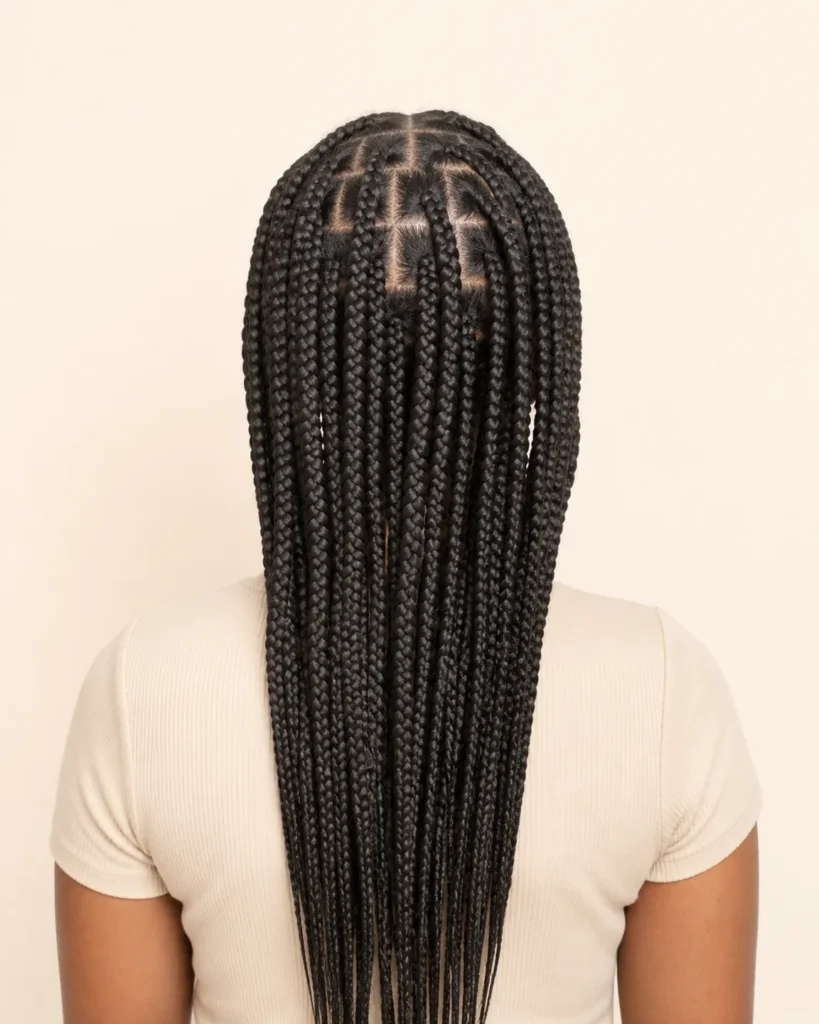
As a general guide, traditional and knotless box braids should be worn for four to six weeks. You do not need to wait until then: pain, stinging, bumps, scabs, breakage or changes to the hairline mean you should take them out sooner.
Quick answer
Use four to six weeks as a guide, not a guarantee. The British Association of Dermatologists advises against leaving braids in for more than six weeks. The American Academy of Dermatology gives six to eight weeks as a maximum, while a dermatologist consulted by Baylor College of Medicine recommends four to six weeks for hair health and considers eight weeks an absolute limit. At AC Trenzas Studio, we take the more cautious approach: six weeks as a general limit, with earlier removal if any warning signs appear.
This guide covers box braids with extensions, both traditional and knotless. If you are unsure how the two techniques differ, you can read our comparison of knotless and traditional box braids before choosing.
Looking good does not mean they should stay in
Wear duration can mean two different things. One is how long a hairstyle keeps defined roots and little frizz. The other is how long your hair and scalp tolerate the weight, tension and build-up that come with extensions.
The finish may still look good when there is significant new growth, tangles at the base or too much tension on the edges. Do not decide based only on a photo, the calendar or the money spent on the hairstyle.
| When | What it means | What to do |
|---|---|---|
| Before 4 weeks | They may need to be removed if there is pain, irritation, breakage or heavy build-up. | Do not wait for a particular date. Loosen or remove the affected section. |
| Between 4 and 6 weeks | This is the cautious time frame we use as general guidance. | Check the roots, edges, cleanliness and comfort to decide when to take them out. |
| More than 6 weeks | Visible new growth, tangles at the base and time under tension all increase. | Do not make this a target. The cautious recommendation is to take them out. |
What can make braids last longer or shorter
Size and weight
Section size and the amount and length of the extensions change the weight each root supports. Very long, heavy or heavily decorated braids need extra care, even when they still look neat.
Installation and tension
Tightening the roots is not a safe way to make braids last longer. Pain during braiding means the section is too tight and needs to be loosened or redone.
New growth and texture
Everyone has a different growth rate and hair texture. Visible space at the roots and frizz change the appearance, but do not prove that braids make hair grow faster.
Sweat, washing and your routine
Exercise, humidity, swimming, washing and products can affect frizz and build-up. These habits cannot be converted into an exact number of days, but they do mean you need to pay attention to washing and drying.
Do traditional box braids and knotless braids last different lengths of time?
There may be a visible difference in appearance, but we do not give them different wear schedules. In traditional box braids, extensions are usually attached at the root, so the base may keep a more defined appearance. Knotless braids begin with natural hair and extensions are added gradually, so frizz and loss of definition at the roots may become visible sooner.
This does not show that one technique always lasts longer or is safer. We have not found direct clinical trials comparing how many weeks each lasts. Size, weight, the braider's grip and care also matter greatly. You can see examples in the traditional box braid gallery and in the knotless box braid gallery.
Do not treat pain as normal
A braid that hurts is too tight. The AAD lists pain, stinging, scabbing and skin lifted or bulging around a braid as warning signs. The BAD agrees that pain after installation indicates too much tension and should not require a painkiller. Do not wait several days for the roots to “loosen up”.
Signs that you need to take them out sooner
Frizz or less defined roots are cosmetic changes. The following signs matter more and should not wait until week six:
- pain, tightness, a headache, stinging or a burning sensation;
- small bumps, spots, redness, swelling or scabs;
- areas of skin lifted or bulging around a braid;
- broken hairs around the forehead, a receding hairline or thinning;
- heavily tangled roots or build-up that does not improve with gentle washing;
- persistent itching or discomfort that returns after washing.
Traction alopecia results from repeated or sustained pulling. A clinical review of this condition explains that it may improve if tension is removed early, but prolonged damage can scar some follicles and make part of the hair loss permanent. If you see a bald patch, a receding hairline or a smooth, shiny area, consult a dermatologist.
How to care for them without trying to keep them in at all costs
- Clean the scalp when it needs it. As a practical guide, the dermatologist consulted by Baylor recommends washing roughly every two weeks while wearing braids. Wash sooner if there is sweat, oil, flaking or build-up.
- Use a gentle shampoo and your fingertips. Do not scratch or rub the roots hard. Rinse thoroughly to avoid leaving residue.
- Let them dry completely. Remove excess water without wringing. If you use a hairdryer, choose low heat and keep the airflow moving.
- Protect your braids at night without tightening them. A scarf, durag or satin bonnet can reduce friction, provided it does not press on the hairline or temples.
- Avoid product build-up. Adding more oil does not solve every itch. Persistent itching may indicate irritation or a scalp condition that needs assessment.
- Avoid wearing tight updos too often. A bun or high ponytail also adds traction to the roots and edges.
In our guide to caring for and washing braids explains the process step by step.
What to check after taking them out
Undo each braid patiently and detangle before washing so shed hair does not become compacted. Then wash, condition and check the hairline and partings in good light. As explained by the dermatologist consulted by Baylor, it is normal to find naturally shed hair that has been trapped for several weeks; bald patches, wounds, inflammation or increasing breakage should not be treated as normal.
The sources consulted do not set a universal one- or two-week break suitable for everyone. Alternating styles and spending time without extensions reduces repeated tension. If there is pain, scabbing, breakage or thinning, do not braid that area again until it recovers; consult a dermatologist if it does not improve.
Common questions
Can I keep them for eight weeks if they still look good?
The AAD mentions six to eight weeks as a maximum, while the BAD advises no more than six. We use six weeks as a cautious limit. A good-looking finish cannot tell you how the follicles are doing or how much tangling there is at the base.
Do knotless braids last less time?
A flatter base may show new growth or frizz sooner, but there is no universal difference in weeks. A well-proportioned installation and daily care also matter, so the technique's name alone cannot predict how long the braids will last.
Can I refresh just the edges?
A cosmetic refresh does not reset the time the rest of the hair has spent under tension. Repeatedly redoing the edges can also stress the finest hairs. If the whole style is close to the limit or feels uncomfortable, it is better to remove it completely.
This is general information and does not replace a medical assessment. Consult a dermatologist if localised hair loss, a receding hairline, pain or inflammation persists after removing the braids.
Sources
- British Association of Dermatologists: caring for Afro-textured hair
- American Academy of Dermatology: hairstyles and traction alopecia
- American Academy of Dermatology: preventing damage from extensions
- Baylor College of Medicine: caring for braids
- Clinical review of traction alopecia
- Hair.com, L’Oréal's professional division: comparing techniques