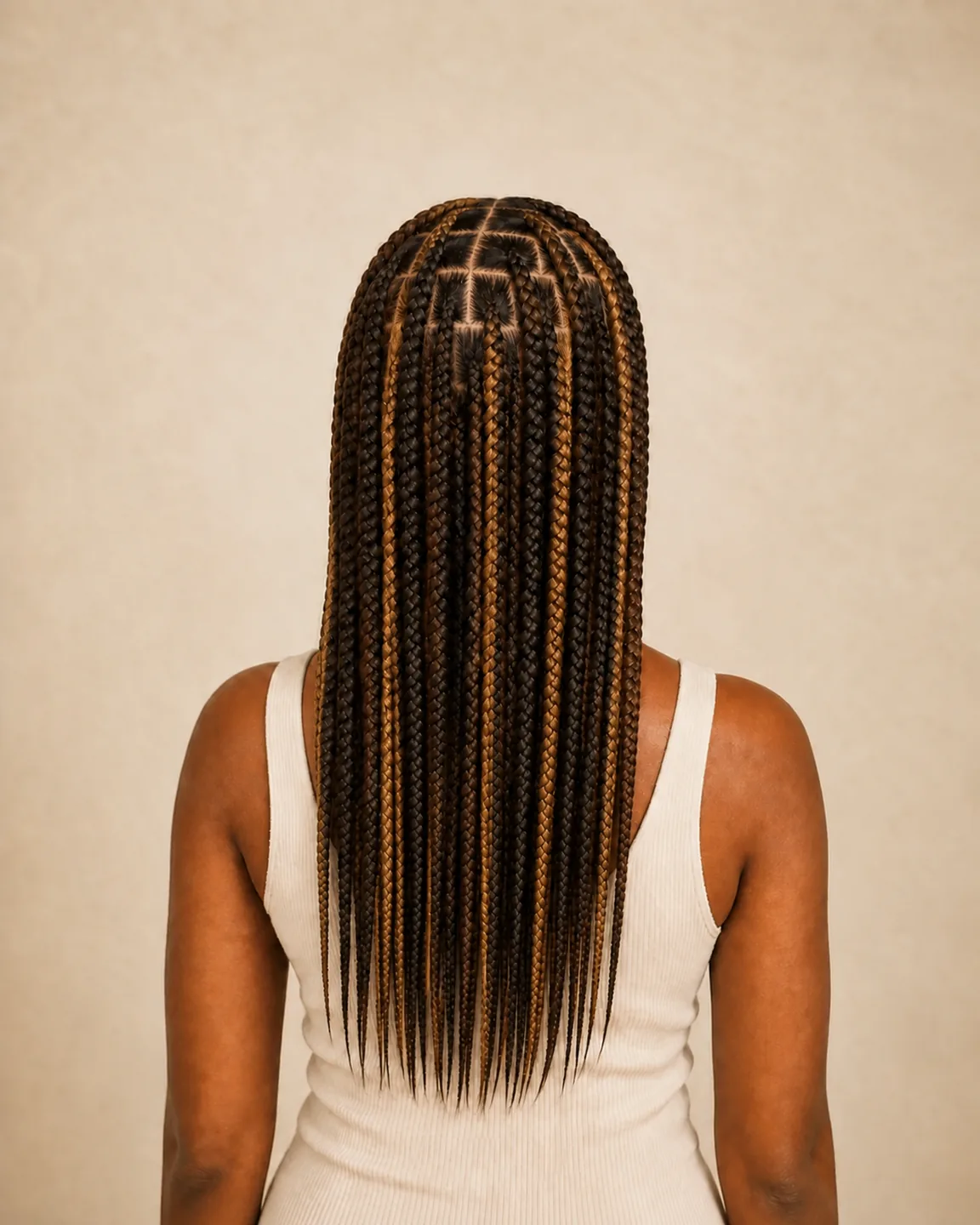
Box braids do not have to look the same every day. With the same set of braids, you can switch from wearing them down to a half-up style, ponytail or bun without rebraiding.
Before you begin
Choose the loosest version that stays in place. An updo is not well made if it hurts, stings or pulls the hairline. When extensions are long, very full or decorated, their weight matters too.
These seven ideas change the shape of the hairstyle, not the installation. If you are still choosing a technique, you can read our comparison of knotless and traditional box braids and see examples in the galleries of traditional box braids and knotless box braids.
Check the weight and roots before putting your braids up
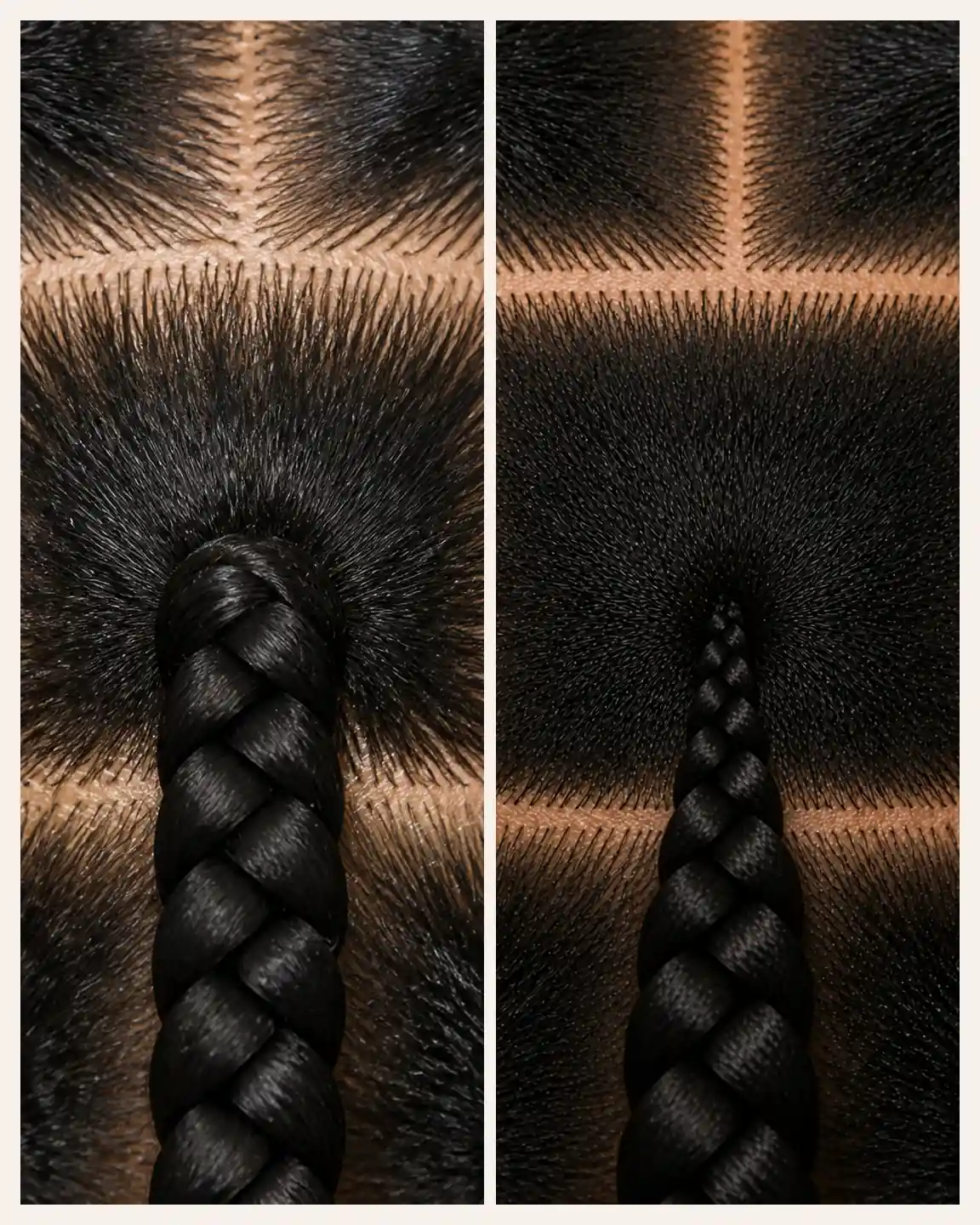
Long, very full or beaded extensions add weight. Tight ponytails and buns also increase tension on the roots.
The American Academy of Dermatology states that a painful hairstyle is too tight. The British Association of Dermatologists also warns about the extra weight of long extensions and decorations, and recommends avoiding tight ponytails and buns.
No hairstyle name guarantees safety. Weight, how it is secured, how often you wear it and how your scalp feels all matter.
Seven ways to wear your box braids
1. Down with a side part

This is the simplest change because it needs no hair tie or updo.
- Let the braids fall in their natural direction.
- Use your fingers to move a few braids from the parting towards one side.
- Place some of the lengths over one shoulder if you want to emphasise the asymmetry.
Do not force all the roots in a new direction. If you feel pulling around the hairline, move fewer braids.
2. Gentle half-up style
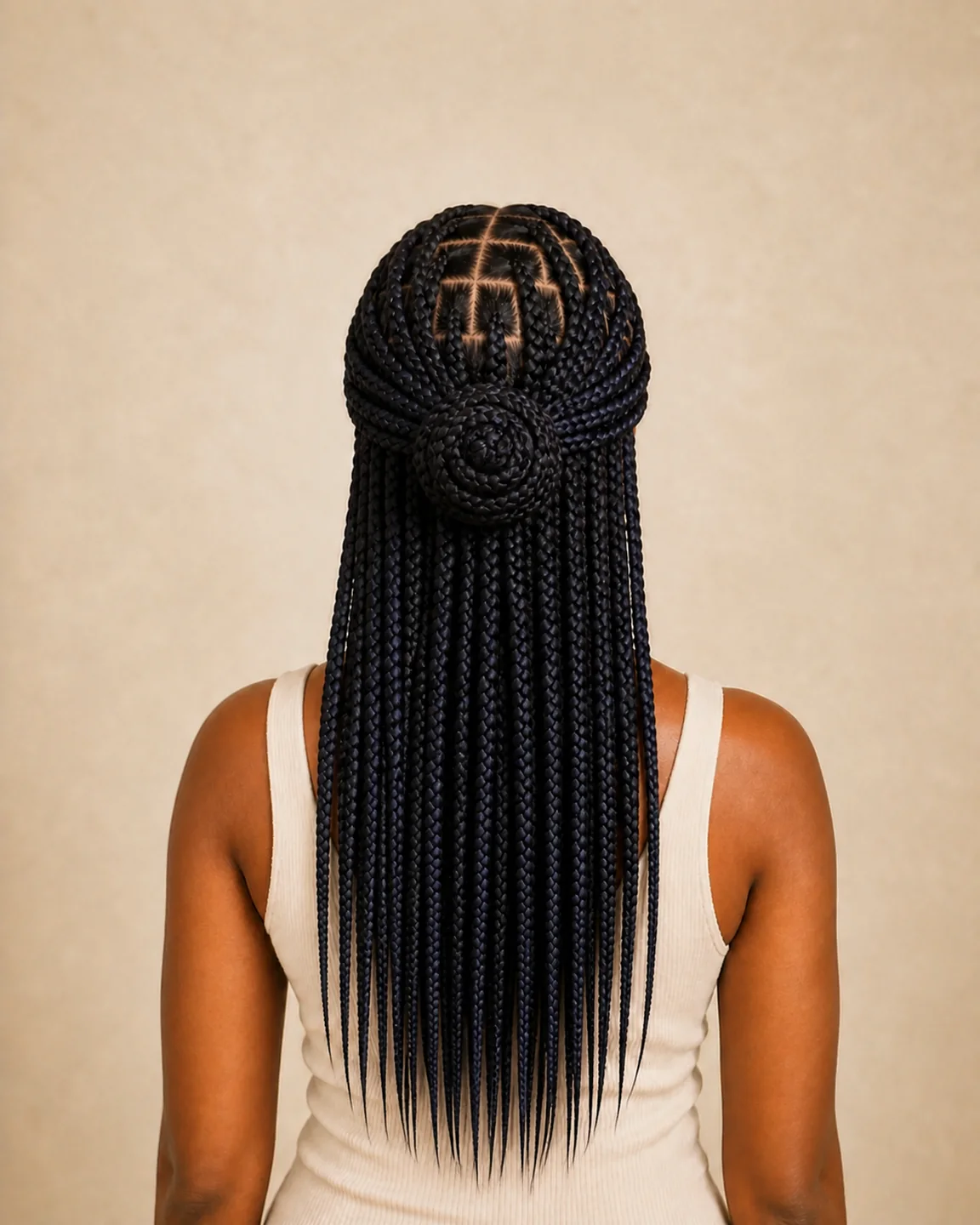
Gathers some of the volume while leaving the remaining braids down.
- Separate some of the top section without pulling the fine hairs around the hairline.
- Bring it towards the back of the head.
- Secure it loosely with a wide covered hair tie or a soft ribbon.
Do not tighten the forehead area for a sleeker finish. A half-up style should let you move your head without feeling pulling.
3. Low ponytail

The low ponytail gathers the lengths at the nape while leaving the root pattern visible.
- Gather the braids gradually while supporting their weight with one hand.
- Position them at the nape without pulling on the front hairline.
- Use a wide hair tie and wrap it only as many times as needed to hold the braids together.
If you need a lot of tension to stop it slipping, loosen the ponytail or gather fewer braids.
4. Thick side braid

In this look, the box braids themselves form one larger braid.
- Bring the braids over one shoulder.
- Divide the braids into three large groups.
- Cross them loosely and secure the end without squeezing it.
The weight shifts to one side. Undo the braid if you feel uneven pulling at the roots or discomfort in your neck.
5. Loose low bun

It creates a more gathered look without lifting all the weight to the crown.
- Gather the braids at the nape.
- Wrap them around a wide base without creating a small, tight spiral.
- Secure the outside of the bun with a large hair tie or a soft ribbon.
If it only stays in place with a lot of pressure or several pins that catch the braids, switch to a half-up style or a low ponytail.
6. High ponytail

It changes the silhouette considerably, but lifts the full weight of the extensions.
- Lift the braids in groups while supporting the lengths.
- Gather them at the crown without pulling on the temples or forehead.
- Secure them with a wide hair tie and check comfort before releasing their weight.
Keep it loose and occasional. If the braids are very long, decorated or pull backwards, choose a lower position.
7. Wide high bun

This creates the biggest change in the series and also needs the most careful weight management.
- Start with a high ponytail that already feels comfortable.
- Divide the lengths into two groups and wrap them around the base in opposite directions.
- Secure the outer section without tightening the roots again.
If the bun needs a very tight ponytail to stay in place, this set of braids is not suitable for that updo. Undo it if you feel any discomfort.
Choosing a style for your braid length
With long or heavy extensions, start by wearing the braids down or in a loose, low updo. A side braid may also work, provided the shifted weight does not feel uncomfortable.
High ponytails and buns lift the full length. Even with knotless braids, the technique's name does not remove the weight or guarantee a comfortable updo.
Signs that you should loosen or undo the style
- pain or tenderness at the roots;
- stinging or a burning sensation;
- redness, bumps, scabs or small lesions;
- areas of the scalp lifted or indented by tension;
- broken hairs around the forehead;
- a receding hairline or localised thinning.
The AAD recommends changing the hairstyle immediately if there is pain, stinging, scabbing or skin lifted by traction. The guide from St George’s University Hospitals NHS adds redness, small bumps and indentations to the early warning signs.
If there is hair loss or discomfort persists after loosening the braids, consult a dermatologist. Repeated traction can eventually cause permanent hair loss.
Do these styles also work with knotless braids?
Yes, the same shapes can be adapted to knotless box braids when the length, thickness and weight allow. The roots usually look flatter, but that does not automatically make a ponytail or bun free of tension.
In our guide to how long box braids and knotless braids last we explain why the condition of your scalp matters more than keeping a hairstyle for a fixed number of weeks.
Alternate updos with rest days
Avoid wearing a style that pulls the roots in the same direction every day. Alternate updos with days when you wear the braids down, and do not tighten them to hide new growth or frizz.
Washing and drying remain important even when you change how you style your braids. You can read our guide to caring for and washing braids.
The right updo changes the appearance of your braids without making you constantly aware of their weight. If it only looks right when you tighten the roots, choose a simpler version.
This is general information and does not replace a medical assessment. Consult a dermatologist if localised hair loss, a receding hairline, pain or inflammation persists after undoing the hairstyle.
Sources
- American Academy of Dermatology: tight hairstyles and traction alopecia
- British Association of Dermatologists: Afro-textured hair care
- St George’s University Hospitals NHS: guide to Afro-textured hair
AC Trenzas Studio
Updated on 22 August 2026